Tampilkan postingan dengan label Cerita dan Foto. Tampilkan semua postingan

Selasa, 04 Agustus 2009

100 Photographs that Changed the World From Life Magazine - 4

Photobucket
Clarence Hailey Long, 1949 - Another Landmark Image

This is C.H. Long, a 39-year-old foreman at the JA ranch in the Texas panhandle, a place described as “320,000 acres of nothing much.” Once a week, Long would ride into town for a store-bought shave and a milk shake. Maybe he’d take in a movie if a western was playing. He said things like, “If it weren’t for a good horse, a woman would be the sweetest thing in the world.” He rolled his own smokes. When the cowboy’s face and story appeared in LIFE in 1949, advertising exec Leo Burnett had an inspiration. The company Philip Morris, which had introduced Marlboro as a woman’s cigarette in 1924, was seeking a new image for the brand, and the Marlboro Man based on Long boosted Marlboro to the top of the worldwide cigarette market.

Photobucket
Lynching 1930

A mob of 10,000 whites took sledgehammers to the county jailhouse doors to get at these two young blacks accused of raping a white girl; the girl’s uncle saved the life of a third by proclaiming the man’s innocence. Although this was Marion, Ind., most of the nearly 5,000 lynchings documented between Reconstruction and the late 1960s were perpetrated in the South. (Hangings, beatings and mutilations were called the sentence of “Judge Lynch.”) Some lynching photos were made into postcards designed to boost white supremacy, but the tortured bodies and grotesquely happy crowds ended up revolting as many as they scared. Today the images remind us that we have not come as far from barbarity as we’d like to think.

Photobucket
Migrant Mother 1936

This California farmworker, age 32, had just sold her tent and the tires off her car to buy food for her seven kids. The family was living on scavenged vegetables and wild birds. Working for the federal government, Dorothea Lange took pictures like this one to document how the Depression colluded with the Dust Bowl to ravage lives. Along with the writing of her economist husband, Paul Taylor, Lange’s work helped convince the public and the government of the need to help field hands. Lange later said that this woman, whose name she did not ask, “seemed to know that my pictures might help her, and so she helped me.”

Photobucket
Galloping Horse 1878

Was there a moment midstride when horses had all hooves off the ground? Leland Stanford, the railroad baron and future university founder, bet there was—or at least that’s the story. It was 1872 when Stanford hired noted landscape photographer Eadweard Muybridge to figure it out. It took years, but Muybridge delivered: He rigged a racetrack with a dozen strings that triggered 12 cameras. Muybridge not only proved Stanford right but also set off the revolution in motion photography that would become movies. Biographer Rebecca Solnit summed up his life: “He is the man who split the second, as dramatic and far-reaching an action as the splitting of the atom.”

Photobucket
Pigeon House and Barn 1827

As early as 1793, Frenchman Nicéphore Niépce and his brother Claude imagined a photographic process, and over the next several years, Nicéphore experimented with various light-sensitive substances and cameras. In 1824 he produced a view from his window on a metal plate covered with asphalt. That and most other pictures fashioned by Niépce in the 1820s no longer exist, but the fuzzy image of a pigeon house and a barn roof taken in the summer of 1827 is a good representation of Niépce’s art. To make what he called a “heliograph,” or sun drawing, Niépce employed an exposure time of more than eight hours. Photography, if not yet practical, had been invented.

Photobucket
How Life Begins 1965

In 1957 he began taking pictures with an endoscope, an instrument that can see inside a body cavity, but when Lennart Nilsson presented the rewards of his work to LIFE’s editors several years later, they demanded that witnesses confirm that they were seeing what they thought they were seeing. Finally convinced, they published a cover story in 1965 that went on for 16 pages, and it created a sensation. Then, and over the intervening years, Nilsson’s painstakingly made pictures informed how humanity feels about . . . well, humanity. They also were appropriated for purposes that Nilsson never intended. Nearly as soon as the 1965 portfolio appeared in LIFE, images from it were enlarged by right-to-life activists and pasted to placards.

Photobucket
Promontory Point 1869

The ceremony begins on May 10, 1869, as an eastbound Central Pacific locomotive and a westbound Union Pacific locomotive meet in Promontory Point, Utah, marking the completion of the first transcontinental railroad. The men on the cowcatchers are ready to toast the driving of the golden spike. The work had been brutal. At one stage, efforts to tunnel through the marble spine of a Sierra Nevada mountain consumed an entire year, as only eight inches a day of progress was possible. So: a fabulous accomplishment. But this is also an early example of a photo op—the use of a picture as a means to an end. Folks back East could see, plain as day, that a train could take them all the way to California, where businessmen anxiously awaited their commerce

Photobucket
Triangle Shirtwaist Company Fire 1911

The Triangle Shirtwaist Company always kept its doors locked to ensure that the young immigrant women stayed stooped over their machines and didn’t steal anything. When a fire broke out on Saturday, March 25, 1911, on the eighth floor of the New York City factory, the locks sealed the workers’ fate. In just 30 minutes, 146 were killed. Witnesses thought the owners were tossing their best fabric out the windows to save it, then realized workers were jumping, sometimes after sharing a kiss (the scene can be viewed now as an eerie precursor to the World Trade Center events of September, 11, 2001, only a mile and a half south). The Triangle disaster spurred a national crusade for workplace safety.


Photobucket
Tiananmen Square 1989

A hunger strike by 3,000 students in Beijing had grown to a protest of more than a million as the injustices of a nation cried for reform. For seven weeks the people and the People’s Republic, in the person of soldiers dispatched by a riven Communist Party, warily eyed each other as the world waited. When this young man simply would not move, standing with his meager bags before a line of tanks, a hero was born. A second hero emerged as the tank driver refused to crush the man, and instead drove his killing machine around him. Soon this dream would end, and blood would fill Tiananmen. But this picture had shown a billion Chinese that there is hope.


Photobucket
Flight 1903

On December 17, 1903, two bicycle mechanics from Ohio realized one of humanity’s wildest dreams: For 12 seconds they were possessed of true flight. Before the day ended, Orville and Wilbur Wright would keep their wood-wire-and-cloth Flyer aloft for 59 seconds. Sober citizens knew that only birds used wings to take to the air, so without being at the site, near Kitty Hawk, N.C., or seeing this photo, few would have believed the Wrights’ story. Although it had taken ages for humans to fly, once the brothers made their breakthrough, the learning curve reached the heavens. Within 15 years of this critical moment, nearly all the elements of the modern airplane had been imagined, if not yet developed.

Photobucket
First Human X-ray 1896

To know something like the back of your hand is a timeless concept, one taken yet further by Wilhelm Konrad Roentgen. While working on a series of experiments with a Crookes tube, he noticed that a bit of barium platinocyanide emitted a fluorescent glow. He then laid a photographic plate behind his wife’s hand (note the wedding rings), and made the first X-ray photo. Before that, physicians were unable to look inside a person’s body without making an incision. Roentgen was the recipient of the first Nobel Prize for Physics in 1901.

100 Photographs that Changed the World From Life Magazine 3

Photobucket
Michael Dukakis, 1988 - Another Landmark Image

After Gary Hart was photographed with a model (no, not his wife) in 1988 on a boat dubbed Monkey Business, Massachusetts Governor Michael Dukakis became the Democrat's choice to run for President against George Bush. At a General Dynamics plant in Michigan, the Duke wanted to show he was no softie on defense, so took a spin in a tank. Compared with the dashing WWII pilot Bush, the little Dukakis came off a clown, and the photo op blew up in his face.

Photobucket
Earthrise 1968

The late adventure photographer Galen Rowell called it “the most influential environmental photograph ever taken.” Captured on Christmas Eve, 1968, near the end of one of the most tumultuous years the U.S. had ever known, the Earthrise photograph inspired contemplation of our fragile existence and our place in the cosmos. For years, Frank Borman and Bill Anders of the Apollo 8 mission each thought that he was the one who took the picture. An investigation of two rolls of film seemed to prove Borman had taken an earlier, black-and-white frame, and the iconic color photograph, which later graced a U.S. postage stamp and several book covers, was by Anders.

Photobucket
Execution of a Viet Cong Guerrilla 1968

With North Vietnam’s Tet Offensive beginning, Nguyen Ngoc Loan, South Vietnam’s national police chief, was doing all he could to keep Viet Cong guerrillas from Saigon. As Loan executed a prisoner who was said to be a Viet Cong captain, AP photographer Eddie Adams opened the shutter. Adams won a Pulitzer Prize for a picture that, as much as any, turned public opinion against the war. Adams felt that many misinterpreted the scene, and when told in 1998 that the immigrant Loan had died of cancer at his home in Burke, Va., he said, “The guy was a hero. America should be crying. I just hate to see him go this way, without people knowing anything about him.”

Photobucket
Betty Grable 1942

World War II took American boys to far-flung places and some rough duty. For many, mail came infrequently at best, and at times it held only a Dear John letter. The troops were desperate for some link to home, some reminder of what they were fighting for. Betty Grable and her million-dollar legs were the perfect balm for what ailed ’em, and this 1942 pinup of the easygoing girl with oodles of back-home charm, and other assets, made the war seem a little more bearable. Sexy pinups later grew to poster size, perhaps most memorably in the endlessly reproduced portrait of Farrah Fawcett.


Photobucket

Johnson Is Sworn In 1963

Lyndon Baines Johnson takes the presidential oath of office on November 22 as Air Force One carries his wife, Lady Bird, Jacqueline Kennedy and several White House aides back to Washington from Dallas. Earlier, President John F. Kennedy had been assassinated, and the speed with which this ceremony was arranged—and the photo released—was purposeful. Johnson and his advisers wanted to assure a shocked nation that the government was stable, the situation under control. Images from the Zapruder film of the shooting, which would raise so many questions, would not be made public for days.


Photobucket
Kent State 1970

When President Richard Nixon said he was sending troops to Cambodia, the nation’s colleges erupted in protest. At Kent State some threw rocks. The Ohio National Guard, called in to quell the turmoil, suddenly turned and fired, killing four; two were simply walking to class. This photo captured a pivotal moment: American soldiers had just killed American kids. Student photographer John Filo won the Pulitzer; the event was also memorialized in a Neil Young song and a TV movie. The girl, Mary Ann Vecchio, turned out not to be a Kent State student, but a 14-year-old runaway. She was sent back to her family in Florida.


Photobucket
Hazel Bryant - Another Landmark Image

It was the fourth school year since segregation had been outlawed by the Supreme Court. Things were not going well, and some southerners accused the national press of distorting matters. This picture, however, gave irrefutable testimony, as Elizabeth Eckford strides through a gantlet of white students, including Hazel Bryant (mouth open the widest), on her way to Little Rock’s Central High.

100 Photographs that Changed the World From Life Magazine 2

Photobucket
Birmingham 1963

For years, Birmingham, Ala., was considered “the South’s toughest city,” home to a large black population and a dominant class of whites that met in frequent, open hostility. Birmingham in 1963 had become the cause célèbre of the black civil rights movement as nonviolent demonstrators led by Rev. Martin Luther King Jr. repeatedly faced jail, dogs and high-velocity hoses in their tireless quest to topple segregation. This picture of people being pummeled by a liquid battering ram rallied support for the plight of the blacks.

Photobucket
The Crimean War 1855

A British solicitor with an artistic bent, Roger Fenton took up the paintbrush and then, after seeing photography on display at the Great Exhibition in Hyde Park in 1851, the camera. Fenton shot landscapes and portraits, and pictures of Queen Victoria’s children at Windsor Castle in 1854. The next year, he was assigned by a print dealer to cover the Crimean War, being waged by England and France against Russia. Thus the war became the first conflict with any substantial photographic record. Battling cholera and broken ribs, lugging his developing lab on a horse-drawn carriage, Fenton produced 350 images. They are stately and sedate for war photography, since neither the queen nor Fenton’s sponsors wanted to see carnage or any evidence of a war that was progressing badly.

Photobucket
Cuban Missile Crisis 1962

On October 22, 1962, after accusing the U.S.S.R. of installing nuclear missiles on Cuba, President John F. Kennedy ordered a blockade of the island. When the Soviet ambassador to the U.N. refused to deny the charge, U.S. ambassador Adlai Stevenson confronted him with these photos of missile sites taken by the high-flying spy plane, the U-2, and the Soviets were compelled to back down. The presentation of seemingly incontrovertible evidence would become known as an “Adlai Stevenson moment.” Robert F. Kennedy later admitted that he and his brother found the grainy images quite baffling, and banked on the interpretation proffered by the CIA: “I, for one, had to take their word for it.”


Photobucket
Cuban Missile Crisis 1962

This photograph. taken on November 10, 1962 (from less than 500 ft. altitude at a speed of 713 mph). Clearly shown are Soviet-built SA-2 surface-to-air missiles (SAMs) in place at launch sites. It is claimed that this was President Kennedy's favorite photo of the installations, and was mounted in the oval office. He used this photo to demonstrate the nature of the threat that the offensive weapons provided. The pattern of dots surrounding the sites are claimed to be camouflage nets..

100 Photographs that Changed the World From Life Magazine

Photobucket
Dead on the Beach 1943

When LIFE ran this stark, haunting photograph of a beach in Papua New Guinea on September 20, 1943, the magazine felt compelled to ask in an adjacent full-page editorial, “Why print this picture, anyway, of three American boys dead upon an alien shore?” Among the reasons: “words are never enough . . . words do not exist to make us see, or know, or feel what it is like, what actually happens.” But there was more to it than that; LIFE was actually publishing in concert with government wishes. President Franklin D. Roosevelt was convinced that Americans had grown too complacent about the war, so he lifted the ban on images depicting U.S. casualties. Strock’s picture and others that followed in LIFE and elsewhere had the desired effect. The public, shocked by combat’s grim realities, was instilled with yet greater resolve to win the war.


Photobucket
Biafra 1969

When the Igbos of eastern Nigeria declared themselves independent in 1967, Nigeria blockaded their fledgling country-Biafra. In three years of war, more than one million people died, mainly of hunger. In famine, children who lack protein often get the disease kwashiorkor, which causes their muscles to waste away and their bellies to protrude. War photographer Don McCullin drew attention to the tragedy. "I was devastated by the sight of 900 children living in one camp in utter squalor at the point of death," he said. "I lost all interest in photographing soldiers in action." The world community intervened to help Biafra, and learned key lessons about dealing with massive hunger exacerbated by war-a problem that still defies simple solutions.


Photobucket
Breaker Boys1910

What Charles Dickens did with words for the underage toilers of London, Lewis Hine did with photographs for the youthful laborers in the United States. In 1908 the National Child Labor Committee was already campaigning to put the nation’s two million young workers back in school when the group hired Hine. The Wisconsin native traveled to half the states, capturing images of children working in mines, mills and on the streets. Here he has photographed “breaker boys,” whose job was to separate coal from slate, in South Pittston, Pa. Once again, pictures swayed the public in a way cold statistics had not, and the country enacted laws banning child labor.


Photobucket
South of the DMZ 1966

Contrary to the constraints that were put upon the press in subsequent conflicts, and even to the embedded program used in the recent Iraqi war, correspondents and photographers in Vietnam could, as Walter Cronkite wrote in LIFE, “accompany troops to wherever they could hitch a ride, and there was no censorship . . . That system—or lack of one—kept the American public well informed of our soldiers’ problems, their setbacks and their heroism.” Reaching Out is a quintessential example of the powerful imagery that came out of Vietnam. “The color photographs of tormented Vietnamese villagers and wounded American conscripts that Larry Burrows took and LIFE published, starting in 1962, certainly fortified the outcry against the American presence in Vietnam,” Susan Sontag wrote in her essay “Looking at War,” in the December 9, 2002, New Yorker. “Burrows was the first important photographer to do a whole war in color—another gain in verisimilitude and shock.” Burrows was killed when the helicopter he was riding in was shot down over Laos in 1971.

Omayra Sánchez [1985]

Photobucket

Omayra Sánchez adalah salah satu dari 25.000 korban bencana gunung berapi nevado del ruiz yang meletus pada 14 November 1985, adalah korban paling manis dan paling tragis dari lumpur keras itu. Selama tiga hari, gadis pemberani ini bertahan hidup di tengah genangan lumpur. Ketika ditemukan, ia masih segar, bicara tentang tes matematika, dan menganjurkan regu penyelamat untuk istirahat. Sebuah ban bekas dikalungkan ke lehernya sebagai penahan agar Omayra tidak tenggelam. Ia tidak segera bisa dikeluarkan dari rawa karena cengkeraman lumpur ternyata sangat ketat. Sesudah terangkat beberapa sentimeter,
Photobucket
Omayra terpaksa ditinggal sendiri. Ketika regu penyelamat kembali dengan pipa penolong, gadis kecil itu sudah kehabisan tenaga. Tak lama kemudian ia meninggal, diiringi rasa pahit getir orang-orang Colombia yang mengetahui bahwa perjuangan menyelamatkannya sia-sia. Tidak heran jika Phil Davison melaporkan bahwa peristiwa lahar Gunung Ruiz adalah kejadian paling mengharukan yang dialaminya selama bertugas sebagai wartawan. Ia juga menulis tentang, seorang ayah yang sebelah lengannya luka parah tapi masih sanggup berjalan 7 km dengan seorang anak menggantung di pundak. (source : Mbm Tempo)

Cerita tentang Sharbat Gula

Foto disamping mungkin sudah ada yang pernah liat di salah satu cover majalah National Geographic edisi perang di afghanistan diakhir2 taun 1980an. foto gadis itu langsung ngetop dimana2,n di taun 1990an foto itu bhkan mpe dpt mcem2 penghargaan..padhal cuma foto seorang gadis.
mungkin yang nganggep itu 'cuma' foto gadis afghanistan itu salah banget!
foto gadis itu sampai2 ngetop di berbagai negara,n smua itu pasti ada sbabnya..
kalu kita liat foto gadis itu, kita pasti bakal tersihir matanya yang anggun dan menawan, dengan menunjukkan ciri khas muka warga afghanistan..tapi mata hijau anggunnya tetp menyihir kita untk bertanya2, "Sapa gadis itu?"
pertanyaan itu juga yang pasti terpkir berulang2 oleh photographernya sendiri, Steve McCurry.
ini adalah true story tentang seorang gadis bermata anggun dari Afghanistan...
diakhir tahun 1980an seorang jurnalis dari majalah National Graphic bernama Steve McCury sdang meliput keadaan di afghanistan yang sedang berlangsung perang dengan soviet ketika itu. di saat dia memotret keadaan di sana, kameranya tanpa sengaja tertuju seorang gadis yang sedang menyendiri di dekat sebuah runtuhan bangunan di jota itu. wajahnya menarik perhatian seorang Steve untuk memotretnya, dan ia pun langsung melangsungkan keinginianya untuk memotret gadis itu.
sekembalinya ia ke negara asalnya, ia pun melanjutkan pekeraanya untuk mencetak fotonya untk national geographic, namun disaat ia mencuci foto gadis itu, ia sangat terpana akan hasil fotonya sndiri. mata indah gadis difotonya seperti mepertontonkan keanggunan sekaligus penderitaan seorang korban perang.ia pun bertanya2 "siapa gadis ini?"
pertanyaan itu terus keputer diotaknya selama bertahun2,hingga ia memberanikan diri untuk kembali ke afghanistan di awal tahun 1990an hanya demi mencari tahu siapa gadis bermata anggun itu.pencarianya berlangsung selama berbulan2,namun sayang ia tidak mendapatkan hasil. niat untuk mencari tahu siapa gadis itu pun ia urungkan.

kembali ke amerika dengan tgan kosong membuat ia kecewa. kecewa itu terus berlangsung selama 15 tahun kemudian.tetapi ia tak patah semangat dan sekali lagi, di tahun 2001 ia kembali ke afghanistan demi gadis itu yang kmngkin telah berumur 30an bila ia masih hidup.
dengan tekad tidak ingin mengulangi kegagalan 15an tahun yang lalu, ia terus mancari wanita afghanistan di fotonya tanpa patah semangat. berbulan2 disana tanpa hasil tidak mmbuat smangatnya reda juga.

suatu hari ia mendapat titik terang, seorang lelaki afghanistan yang ia tanyai ternyata mengaku sebagai suami gadis di foto yang Steve bawa. pria itu bernama Rahmat Gul.
ia lalu membawa steve ke rumahnya yang terletak jauh dri kota,dan di rumahnya,hasil jerih payahnya selama bertahun2 terbayar sudah.di rumah itu seorang wanita berusia 30an tengah duduk di ruang tamu legkap dengan pakaian muslim dan cadar menutp mukanya,namun tidk menutup mata anggunya.mata anggun itu menjawab pertanyaan slama bertahun2 di kpala Steve.
slama bertahun2 tidak mmbuat mata angggunya berubah, tetap sperti di foto ketika ia berusia 13 tahun.wanita itu menceritakan tantang khidpany setelah perang itu,ia telah memiliki 3 anak, Robina,Zahida, dan Alia.
pertanyaan steve slama bertahun2pun ia utarakan kepada wanita itu "Siapa nama anda?"
"Sharbat Gula." jawab wanita dengn mata anggun itu.

Stricken child crawling towards a food camp [1994]

Photobucket

Foto tersebut diambil oleh Kevin Carter, seorang photografer asal Afrika Selatan.
Foto tersebut diambil tahun 1993 di Sudan bagian Selatan, dan di bulan May 1994 Carter memenangkan Pulitzer untuk foto tersebut.

Foto yang anda lihat adalah foto seorang gadis kecil yang hampir mati kelaparan, sedangkan di belakangnya tampak seekor burung pemakan bangkai yang menanti dengan sabar saat untuk memangsa gadis kecil tadi.

2 bulan sesudah menerima Pulitzer Kevin Carter bunuh diri dengan cara menghirup zat beracun yang dihubungkan melalui sebuah pipa kedalam pick up truknya.

Menurut pengakuan seorang temannya, Carter diketahui mengalami depresi yang sangat berat dan tidak henti2nya menangis dan menyalahkan dirinya sendiri.
Ini dikarenakan, sesaat setelah mengambil foto tadi, Carter langsung meninggalkan gadis kecil itu sendirian, dan hingga kini dunia tidak mengetahui apa yang kemudian terjadi pada gadis itu.

Selama sisa hidupnya Kevin Carter tidak pernah berhenti dihantui oleh perasaan bersalah, dan dunia juga demikian. Amerika mengulurkan bantuan yang besar kepada Sudan, sesudah foto2 Kevin Carter di publikasikan di media massa.

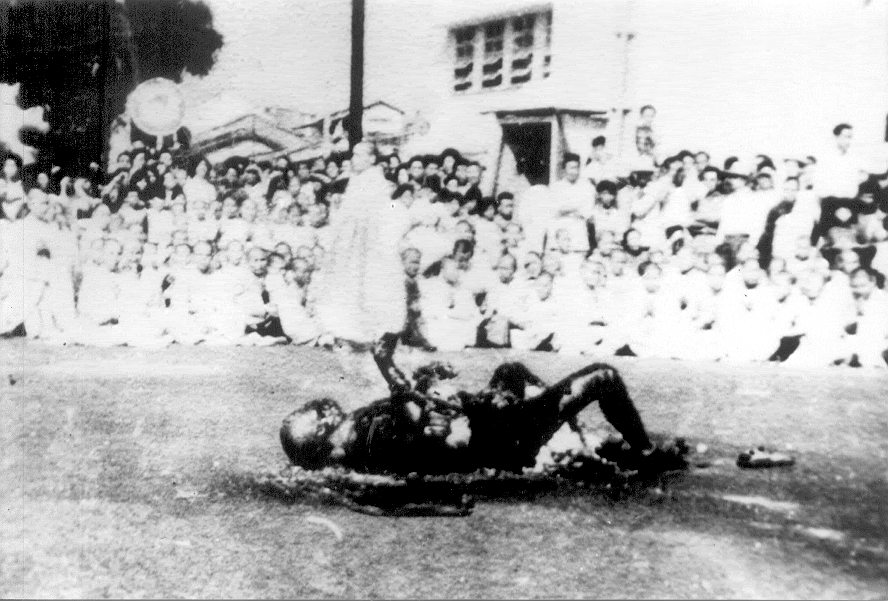
Protes Seorang Biksu dengan Membakar Diri

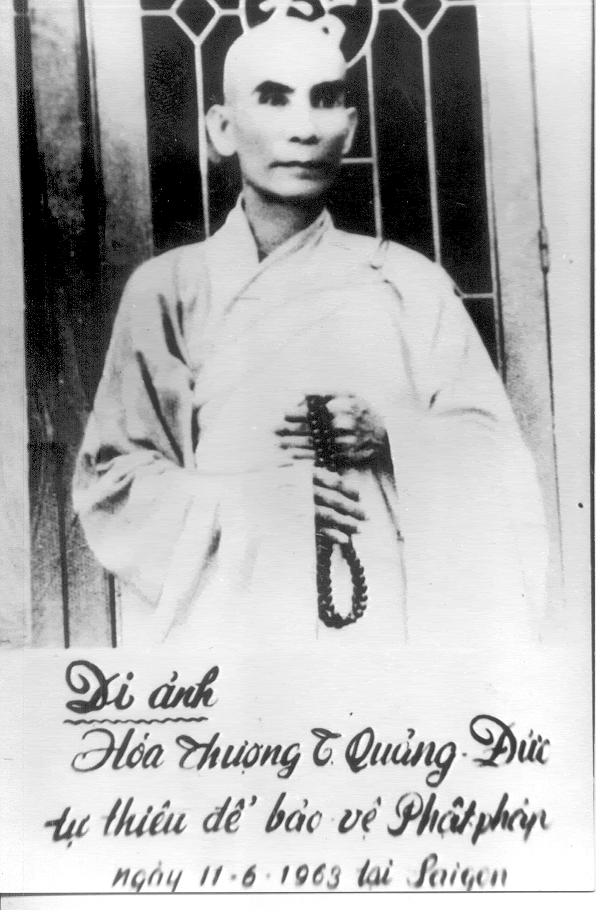
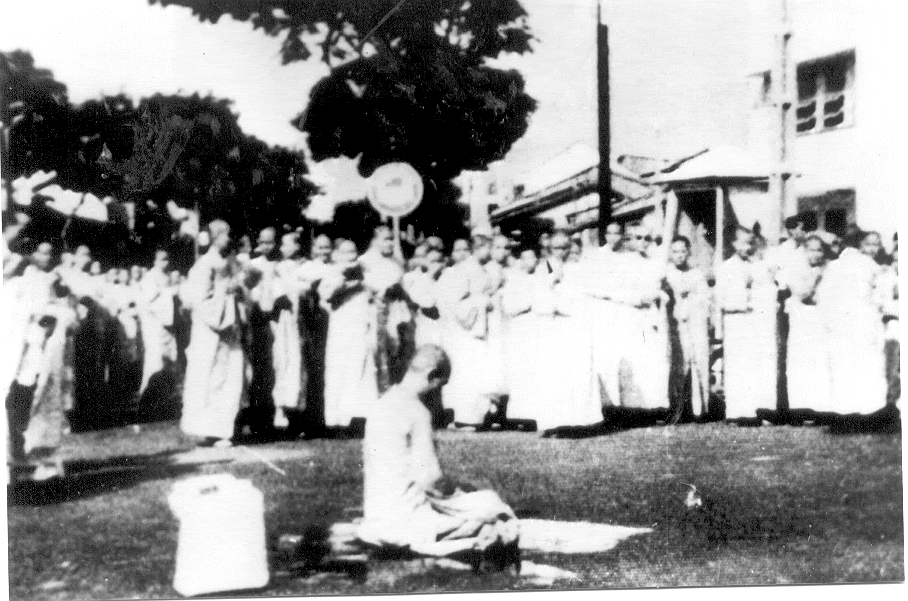
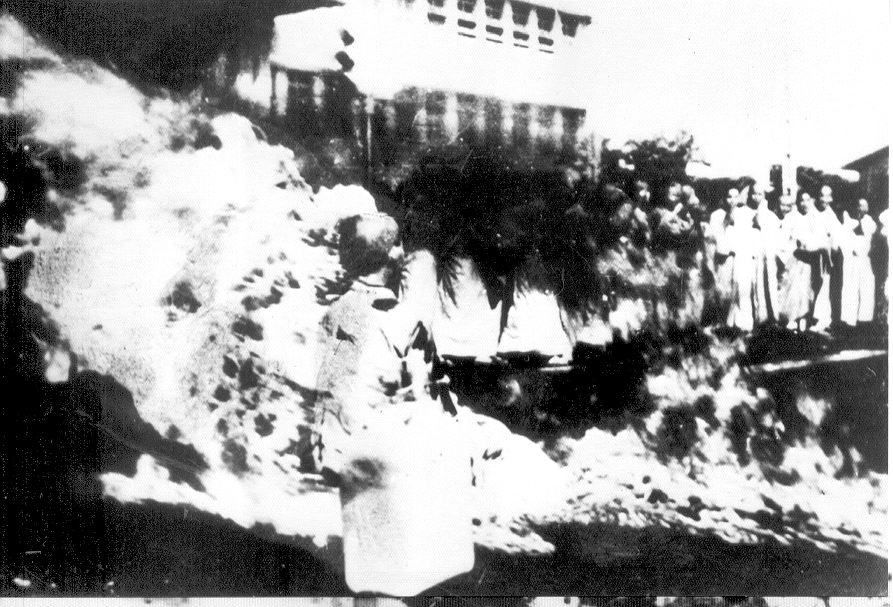
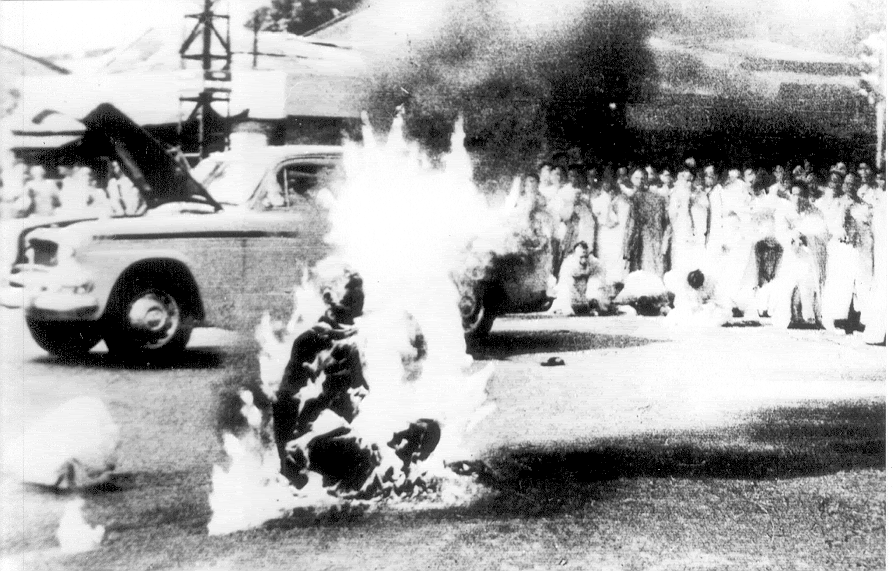
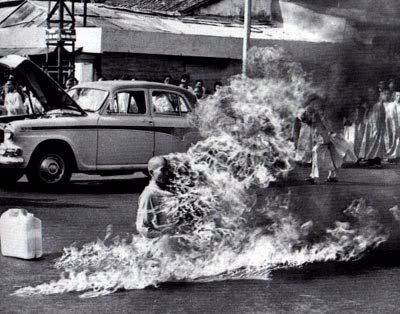
Burning Monk - The Self-Immolation [1963]


Pada tanggal 11 juni 1963, seorang biksu Buddha yg bernama Thich Quang Duc, membakar dirinya sendiri di sebuah persimpangan padat pusat kota Saigon, Vietnam

saksi2 ditempat pd peristiwa itu menuturkan, bahwa biksu Thich Quang Duc bersama beberapa biksu lainnya sampai ke lokasi dengan mengendarai sebuah mobil. Thich Quang Duc keluar dari mobil tsbt dan langsung mengambil posisi lotus tradisional di tengah jalanan yg ramai tersebut dan rekan2 sesama biksu membantu dia meniramkan bensin ke sekujur tubuhnya sendiri. dia menyalakan api dengan korek api dan langsung membakar seluruh tubuhnya dalam beberapa menit.
Yang buat gw angkat jempol( saluutt!) saksi2 menambahkan.. dr awal api membakar tubuh Thich Quang Duc, sampai dia detik2 terakir dia meninggal dengan tubuh yg hangus terbakar, dy sama skali tidak bergerak,not even a muscle!
dan tak ada suara apapun yg keluar dr mulut biksu tersebut..
ketenangan yang diperlihatkan biksu Thich Quang Duc, membuat perbedaan yg mencolok dengan kegaduhan dan ratapan
orang2 yg melihat langsung disekitarnya..


kejadian ini di abadikan oleh David Halberstam, seorang reporter New York Times kebetulan berada di dekat lokasi kejadian. david berada di vietnam utk meliputi perang di negara tersebut, dan foto dbawah ini menjadi salah satu dr world famous pictures

mungkin juragan2 mempertanyakan kenapa biksu ini melakukan perbuatan yg sangat tidak masuk akal?
tetapi sesungguhnya, biksu Thich Quang Duc melakukan hal yg dikenal dengan istilah The Self-Immolation (pengorbanan diri sendiri)
adalah untuk menunjukkan sikap protes menuntut kesamaan hak bagi para penganut ajaran Buddha dengan rezim Diem. sebelumnya para biksu2 di Vietnam sering melakukan protes atas tindakan kaum2 mayoritas yg menghambat
sampai dengan segala usaha pembantaian yg dilakukan pihak2 tertentu terhadap para penganut ajaran Buddha.
mereaka jg menuntut keadilan ditegakkan atas pihak2 yg bertanggungjawab melakukan kejahatan manusia.Namun semua bentuk protes para biksu2 ini tidak memperoleh tanggapan dr rezim Deim sehingga puncaknya,biksu Thich Quang Duc melakukan aksi pengorbanan diri nya sendiri..

setelah kematiannya, biksu ini di kremasi dan menurut legenda, pada saat dkremasi, hati dr biksu Thich Quang Duc tidak terbakar seperti anggota tubuh lainnya yg telah menjadi abu.. akhirnya hati dr almarhum biksu tersebut dianggap suci dan disimpan sampai skrg di Buddhist Temple.